
How to Keep Networking Without Burning Out
Using The Connection Loop at the right volume for your life

Welcome to issue #182 of The Introverted Networker. Every Tuesday, I teach you to be a better networker. My favorite part of the week is hearing from my readers, so leave a comment or ask a question, if you are so inclined.
Everything feels harder than it should be.
I hear the following statement all the time.
“I know I should be networking, but I can’t make myself go to another networking event.”
What people usually mean is this:
Their calendar is already full.
Their energy is already low.
And it feels like everything takes more effort than it should.
Now, layer layoffs on top of that.
When companies announce cuts, the pressure spikes fast.
Even if you’re not directly affected, it’s hard not to feel on edge.
Suddenly, networking feels less like something optional and more like something you’re behind on.
That combination is what makes people shut down.
But this week, I’m going to show you how network without getting overwhelmed.
This issue takes about 4 minutes to read…

The false choice we keep getting
We talk about networking like it’s either off or fully on.
Either you avoid it completely because you don’t want events, small talk, or forced conversations.
Or you panic and crank it up.
You send messages everywhere.
You book calls you don’t really want.
You tell yourself you’ll get serious about networking this week.
Both reactions come from the same broken model.
They assume networking is a switch, not a dial.
A better way to think about it
The Connection Loop isn’t an all-or-nothing system.
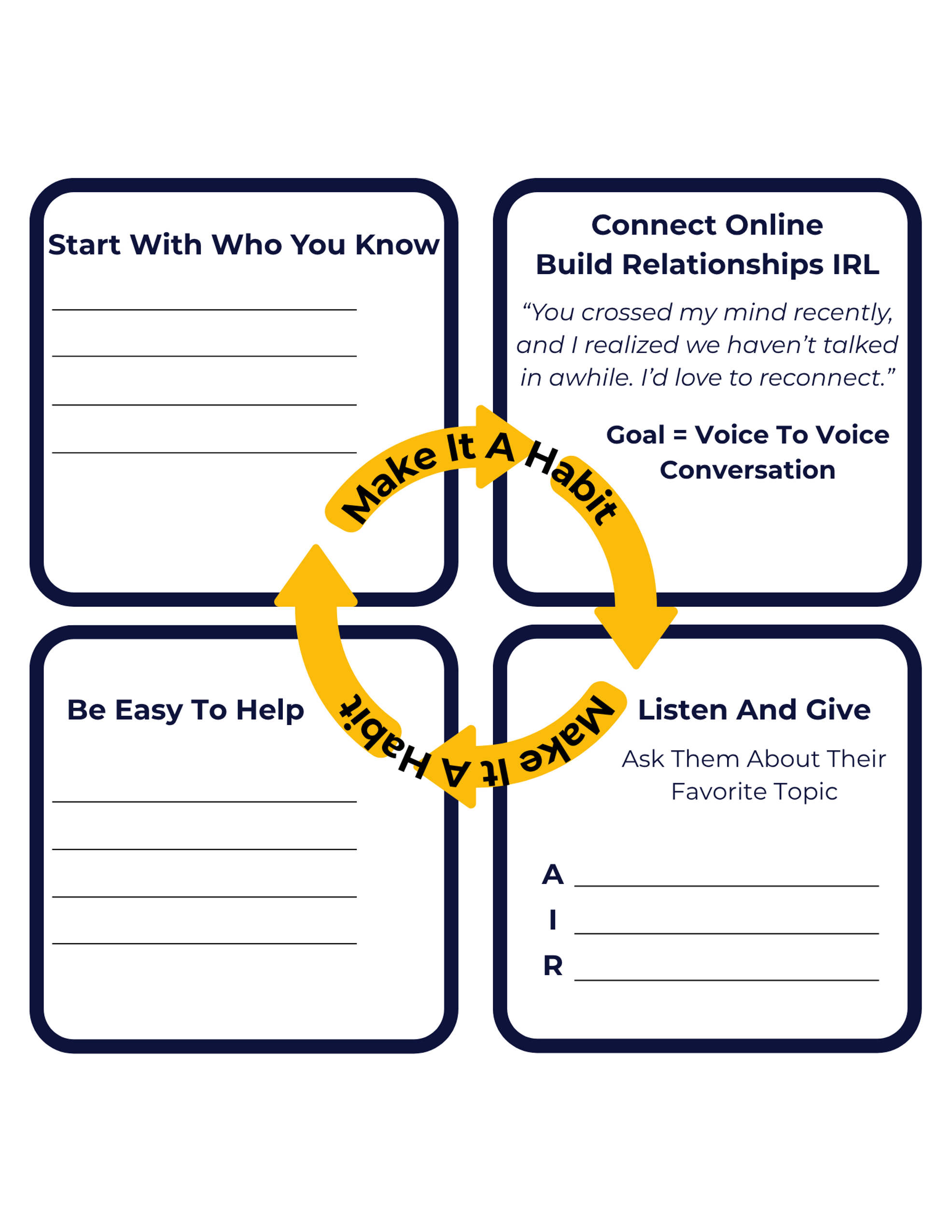
It has a volume knob.
The behaviors don’t change.
The system doesn’t change.
What changes is the intensity.
Some weeks you barely touch it.
Other weeks you lean in harder.
The key is that it never fully shuts off.
That’s what makes it sustainable.
What low volume actually looks like
Low volume networking is quiet and unremarkable, but immensely valuable.
It looks like ten minutes on a Friday afternoon.
Scanning old emails.
Scrolling LinkedIn messages you never replied to.
Reading their posts and thinking, “I wonder how they’re doing.”
Then sending a note like, “It’s been a while. How have you been?”
No event.
No pitch.
No agenda.
This counts.
If that’s all you have in you right now, it’s enough.
You’re staying connected in a way that fits your energy instead of fighting it.
Why low volume matters in the age of layoffs
This is the part people underestimate.
When layoffs hit, the people who feel the most stuck are often the ones who waited until panic set in.
They haven’t talked to anyone outside their immediate circle in years, so every outreach feels heavy.
Low volume connection creates optionality before urgency.
It keeps relationships warm.
It makes future conversations easier.
It gives you people to talk to without needing a reason.
You’re not asking for anything.
You’re just staying human.
When the volume needs to go up
There are seasons when it makes sense to turn the dial higher.
When you’re on an active job search, you’re cranking up that volume knob!
Or, when there is some specific help you need from your network, you want to go all out to re-ignite your connections.
When I was looking to speak at a conference, I reached out to people to get them to vote on my topic.
I had a clear reason to contact them and a direct ask.
I didn’t get the speaking slot.
What I did get were conversations.
Advice.
Reconnections with people I hadn’t talked to in years.
The results of the outreach have been better than getting the speaking slot.
If I had landed it, that would have been gravy.
The meat and potatoes was the partnerships and opportunities from sending the messages to my network.
Sometimes you just need a reason to re-enter someone’s inbox.
The outcome you expect isn’t always the one that matters.
The best thing about The Connection Loop is you can turn the volume up or down depending on what situation you are in.
What turning it to 11 really means
High volume doesn’t mean a different approach.
It’s the same Connection Loop, just repeated more often.
More conversations.
More follow-ups.
More time blocked for connection.
The important nuance is this:
This is for whatever situation you are in right now.
Some weeks the volume is at 1.
Some weeks it’s higher.
And yes, in certain situations, it might even go to 11.
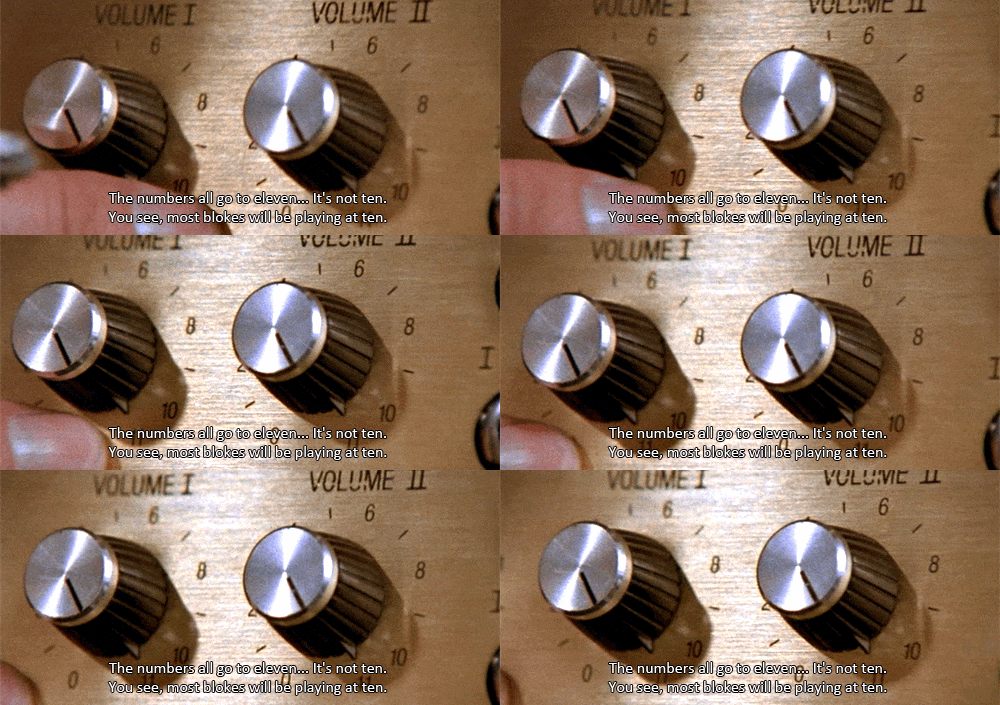
The mistake is thinking it has to stay there.
You’re allowed to turn it up for a stretch.
You’re also allowed to turn it back down when you get to the next stage of your life.
Most importantly:
Don’t ever turn it off completely!
The part that makes this sustainable
You don’t need to network like anyone else.
You don’t need to match someone else’s pace or personality.
You just need a system that stays on, even when the volume is low.
Turn it up when you need to.
Turn it down when you don’t.
That’s how this becomes something you can live with, not another thing you avoid.
If you want to learn more about The Connection Loop, let me know if the comments!
This is such a practical way to reframe networking, Greg.
I love the “volume knob” analogy; it makes networking feel manageable instead of overwhelming. Low-volume connection is such a powerful idea: small gestures, check-ins, and thoughtful messages keep relationships warm without burning you out.
Thanks for sharing this!